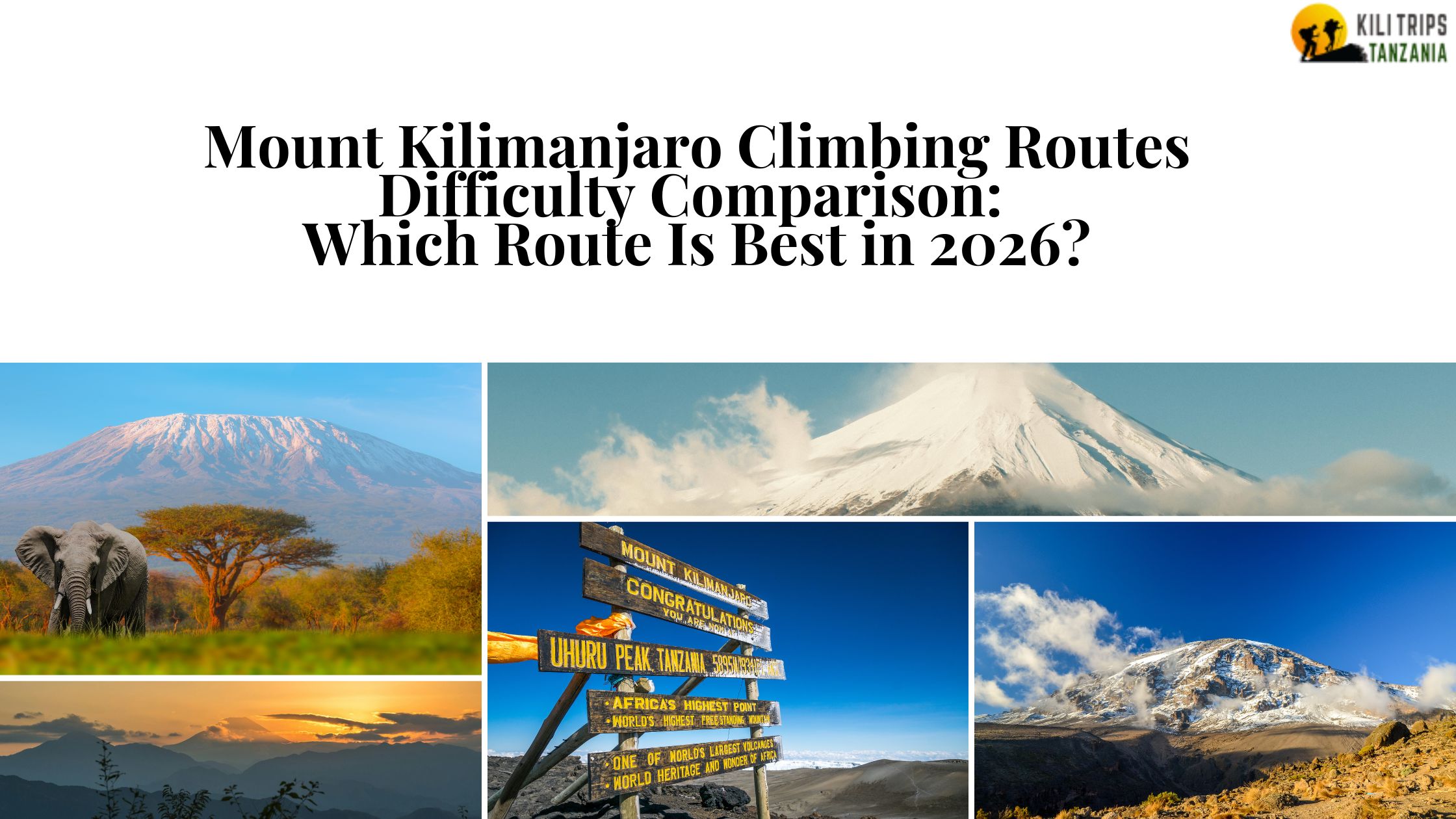
Mount Kilimanjaro climbing routes difficulty comparison reveals that the most appropriate route is the one that is within your capability and that enables you to climb comfortably.
">
Mount Kilimanjaro climbing routes difficulty comparison reveals that the most appropriate route is the one that is within your capability and that enables you to climb comfortably.
">
Kilimanjaro climb planning may be both thrilling and disorienting. The most common question that many trekkers will pose before booking is, " Which route is best? It depends on your fitness, budget, time, and goals of the summit. That is why a definite Mount Kilimanjaro climbing routes difficulty comparison is so helpful. The issue with route choice is still relevant in 2026, since altitude disproportionately impacts every climber. Other paths are more acclimatizing and safer.
Some are shorter, steeper, or more crowded. This guide gives each route in a clear manner, and thus, you are allowed to select the one that works best for you.
Mount Kilimanjaro is not a technical mountain but a trekking peak. Most of the routes do not require ropes. However, altitude is the real challenge. Most climbers are very strong at the beginning, but the thin air is getting tougher every day. As a result, the path you follow can enhance or diminish your chances of reaching the summit.
A fine path does not just get you to the top of the mountain. It also assists your body to adapt gradually. Thus, more extended paths tend to provide a more successful summit. The shorter paths might appear to be less expensive; however, they tend to complicate the climb. The shortest is not always the best way. Rather, it is the one that offers you time to adjust.
Lemosho is the best overall route for 2026. It offers powerful acclimatization, excellent scenery, and a high probability of summit success. The Northern Circuit is frequently the most effective choice for the greatest success. Marangu is good in case you wish to have hut accommodation. In case you want a less busy road, Rongai is fine. Umbwe is the most difficult regular route, if you want the hardest one. This Kilimanjaro climbing routes comparison suggests that there is no one route that suits all climbers, yet there are routes that suit the majority of individuals.
It is useful to know what makes a route difficult so that one can compare the routes before. Challenges on Kilimanjaro do not involve steep parts only. It is also conditional upon the manner in which your body adapts to altitude in a few days.
The following are the key factors:
When route comparing, do not look only at distance. Concentrate on the route, assisting your body in the climb.
Mount Kilimanjaro Routes Comparison
1. Lemosho Route: Best overall choice
First-time climbers usually tend to choose Lemosho. It begins on the west of the mountain and makes a lengthy, gradual approach. Due to that, it can be acclimatized better than several shorter routes. It is also a good place to see a great landscape with rainforest, moorland, lava formations, and expansive mountainous landscape.
This is a seven or eight-day route. The additional time makes numerous trekkers feel more powerful during the summit night. Furthermore, Lemosho is added to the southern route later, and therefore, the initial stretch is more tranquil.
Difficulty level: Moderate
Best: First-time climbers, photographers, and individuals seeking the most desirable balance.
Key disadvantage: More expensive than shorter routes.
2. Machame Route: Scenic but more demanding
One of the most popular routes in Kilimanjaro is Machame. It is renowned for its scenic beauty and for achieving a high rate of success when completed in seven days. Nevertheless, the path is stiffer than Lemosho in various places. Consequently, it makes it a bit more challenging for many trekkers.
Nevertheless, Machame is still a very intelligent option among fit climbers. It has a good climb high, sleep low pattern that helps in acclimatization. Conversely, it might be congested in high seasons of climbing. Thus, it is appropriate with individuals who like an active trail and are not afraid to share the camps.
Level of difficulty: Intermediate to difficult.
Best: Active trekkers seeking scenery and value.
Primary disadvantage: Trailed and steeper parts.
3. Marangu Route: More comfort, less acclimatization time
Marangu is referred to as the Coca-Cola Route. It has only a major route that has hut accommodation rather than tents. That makes it attractive to trekkers who desire more comfort at night. You are sleeping in mountain huts, something that is easier for some climbers.
But comfort is not necessarily more successful. Marangu can be done within five or six days. It has less time due to its brevity in which to acclimatize. Thus, altitude is a bigger issue to some trekkers here than on more extended camping trails. So, Marangu might find it easier as regards sleeping arrangements, and harder as regards summit achievement.
Difficulty level: Moderate
Best: Trekkers who prefer huts over tents.
Primary disadvantage: Reduced acclimatization profile.
4. Rongai Route: Quiet and steady
Kilimanjaro is approached from the north by Rongai. It tends to be drier than the southern trajectories, and thus, it is a better alternative during rainy seasons. Moreover, it gets fewer climbers, hence the trail is less noisy and peaceful.
It is not too aggressive, and the slope is quite stable. For that reason, Rongai is easy to manage for many trekkers. Even so, the terrain is not as diverse as Lemosho or Machame. Therefore, it is less dramatic in terms of visual experience, and not as peaceful and softer as it might have been.
Difficulty level: Moderate
Best: Climbers who desire fewer crowds and a drier route.
Primary disadvantage: A lack of scenic variety.
5. Northern Circuit: Best for acclimatization
The longest normal route on Kilimanjaro is the Northern Circuit. This is precisely the reason why it works well. The additional days will also provide your body with increased time to adapt, leading to greater success in reaching the summit. In addition, the path goes around much of the mountain, thus making it feel even more isolated and not as full.
This path is not the steepest, but it is long. You require time, more energy, and a larger budget. Nevertheless, the Northern Circuit is among the most secure and intelligent options for climbers who have the time to spare days. This is why many experts highly rate it.
Challengeness: Not very hard, but challenging.
Best for: Careful climbers who want the best acclimatization
Primary disadvantage: Increased cost and longer time.
6. Umbwe Path: The most difficult standard path
Umbwe is generally regarded as the most difficult normal climb on Mount Kilimanjaro. It is abrupt, hasty, and violent at the outset. Since it reaches an altitude at a rapid rate, it does not provide much time to allow your body to acclimatize. This makes it an inappropriate option among first-time trekkers.
Yes, it can be a challenge for very strong and experienced hikers. Nevertheless, it should not be used by most climbers. Fitness will never resolve altitude issues. Thus, Umbwe is more suitable for those who are familiar with high altitude trekking, as well as the response of their bodies.
Challenges: The difficulty level is very high.
Recommended: Only experienced climbers.
Key disadvantage: Rapid ascending and reduced acclimatization.
When you are climbing in 2026, pick by success, not just by price. It might be a cheap route, but when you fail to make it to the summit or when you are miserable up the mountain, it turns out to be expensive. Rather, reserve a path that allows the body to acclimatize and allows time.
Select Lemosho for the overall experience. Select Northern Circuit when you wish to be more acclimatized and have additional time. Select Machame when you need a good compromise between quality and price. In the meantime, select Marangu, where the comfort of the hut is the chief consideration. Rongai is the best place to make quiet ascents, and Umbwe is only suitable for experienced climbers. This last Mount Kilimanjaro climbing routes difficulty comparison makes one thing clear: the long routes tend to prevail.
Conclusion
The selection of the Kilimanjaro route may entirely determine your climb. A prudent decision enhances comfort, security, and peak achievement. That is the reason why route research is important prior to booking. Lemosho has the best balance in 2026 in the eyes of most climbers.
The Northern Circuit, in the meantime, is the least challenging to pace, and Machame is more befitting to the stronger trekkers. Rongai is peaceful, Marangu has huts, and Umbwe is the greatest challenge. Ultimately, this Mount Kilimanjaro climbing routes difficulty comparison reveals that the most appropriate route is the one that is within your capability and that enables you to climb comfortably.
">
Mount Kilimanjaro climbing routes difficulty comparison is so helpful. The issue with route choice is still relevant in 2026, since altitude disproportionately impacts every climber. Other paths are more acclimatizing and safer.
Some are shorter, steeper, or more crowded. This guide gives each route in a clear manner, and thus, you are allowed to select the one that works best for you.
Mount Kilimanjaro is not a technical mountain but a trekking peak. Most of the routes do not require ropes. However, altitude is the real challenge. Most climbers are very strong at the beginning, but the thin air is getting tougher every day. As a result, the path you follow can enhance or diminish your chances of reaching the summit.
A fine path does not just get you to the top of the mountain. It also assists your body to adapt gradually. Thus, more extended paths tend to provide a more successful summit. The shorter paths might appear to be less expensive; however, they tend to complicate the climb. The shortest is not always the best way. Rather, it is the one that offers you time to adjust.
Lemosho is the best overall route for 2026. It offers powerful acclimatization, excellent scenery, and a high probability of summit success. The Northern Circuit is frequently the most effective choice for the greatest success. Marangu is good in case you wish to have hut accommodation. In case you want a less busy road, Rongai is fine. Umbwe is the most difficult regular route, if you want the hardest one. This Kilimanjaro climbing routes comparison suggests that there is no one route that suits all climbers, yet there are routes that suit the majority of individuals.
It is useful to know what makes a route difficult so that one can compare the routes before. Challenges on Kilimanjaro do not involve steep parts only. It is also conditional upon the manner in which your body adapts to altitude in a few days.
The following are the key factors:
When route comparing, do not look only at distance. Concentrate on the route, assisting your body in the climb.
Mount Kilimanjaro Routes Comparison
1. Lemosho Route: Best overall choice
First-time climbers usually tend to choose Lemosho. It begins on the west of the mountain and makes a lengthy, gradual approach. Due to that, it can be acclimatized better than several shorter routes. It is also a good place to see a great landscape with rainforest, moorland, lava formations, and expansive mountainous landscape.
This is a seven or eight-day route. The additional time makes numerous trekkers feel more powerful during the summit night. Furthermore, Lemosho is added to the southern route later, and therefore, the initial stretch is more tranquil.
Difficulty level: Moderate
Best: First-time climbers, photographers, and individuals seeking the most desirable balance.
Key disadvantage: More expensive than shorter routes.
2. Machame Route: Scenic but more demanding
One of the most popular routes in Kilimanjaro is Machame. It is renowned for its scenic beauty and for achieving a high rate of success when completed in seven days. Nevertheless, the path is stiffer than Lemosho in various places. Consequently, it makes it a bit more challenging for many trekkers.
Nevertheless, Machame is still a very intelligent option among fit climbers. It has a good climb high, sleep low pattern that helps in acclimatization. Conversely, it might be congested in high seasons of climbing. Thus, it is appropriate with individuals who like an active trail and are not afraid to share the camps.
Level of difficulty: Intermediate to difficult.
Best: Active trekkers seeking scenery and value.
Primary disadvantage: Trailed and steeper parts.
3. Marangu Route: More comfort, less acclimatization time
Marangu is referred to as the Coca-Cola Route. It has only a major route that has hut accommodation rather than tents. That makes it attractive to trekkers who desire more comfort at night. You are sleeping in mountain huts, something that is easier for some climbers.
But comfort is not necessarily more successful. Marangu can be done within five or six days. It has less time due to its brevity in which to acclimatize. Thus, altitude is a bigger issue to some trekkers here than on more extended camping trails. So, Marangu might find it easier as regards sleeping arrangements, and harder as regards summit achievement.
Difficulty level: Moderate
Best: Trekkers who prefer huts over tents.
Primary disadvantage: Reduced acclimatization profile.
4. Rongai Route: Quiet and steady
Kilimanjaro is approached from the north by Rongai. It tends to be drier than the southern trajectories, and thus, it is a better alternative during rainy seasons. Moreover, it gets fewer climbers, hence the trail is less noisy and peaceful.
It is not too aggressive, and the slope is quite stable. For that reason, Rongai is easy to manage for many trekkers. Even so, the terrain is not as diverse as Lemosho or Machame. Therefore, it is less dramatic in terms of visual experience, and not as peaceful and softer as it might have been.
Difficulty level: Moderate
Best: Climbers who desire fewer crowds and a drier route.
Primary disadvantage: A lack of scenic variety.
5. Northern Circuit: Best for acclimatization
The longest normal route on Kilimanjaro is the Northern Circuit. This is precisely the reason why it works well. The additional days will also provide your body with increased time to adapt, leading to greater success in reaching the summit. In addition, the path goes around much of the mountain, thus making it feel even more isolated and not as full.
This path is not the steepest, but it is long. You require time, more energy, and a larger budget. Nevertheless, the Northern Circuit is among the most secure and intelligent options for climbers who have the time to spare days. This is why many experts highly rate it.
Challengeness: Not very hard, but challenging.
Best for: Careful climbers who want the best acclimatization
Primary disadvantage: Increased cost and longer time.
6. Umbwe Path: The most difficult standard path
Umbwe is generally regarded as the most difficult normal climb on Mount Kilimanjaro. It is abrupt, hasty, and violent at the outset. Since it reaches an altitude at a rapid rate, it does not provide much time to allow your body to acclimatize. This makes it an inappropriate option among first-time trekkers.
Yes, it can be a challenge for very strong and experienced hikers. Nevertheless, it should not be used by most climbers. Fitness will never resolve altitude issues. Thus, Umbwe is more suitable for those who are familiar with high altitude trekking, as well as the response of their bodies.
Challenges: The difficulty level is very high.
Recommended: Only experienced climbers.
Key disadvantage: Rapid ascending and reduced acclimatization.
When you are climbing in 2026, pick by success, not just by price. It might be a cheap route, but when you fail to make it to the summit or when you are miserable up the mountain, it turns out to be expensive. Rather, reserve a path that allows the body to acclimatize and allows time.
Select Lemosho for the overall experience. Select Northern Circuit when you wish to be more acclimatized and have additional time. Select Machame when you need a good compromise between quality and price. In the meantime, select Marangu, where the comfort of the hut is the chief consideration. Rongai is the best place to make quiet ascents, and Umbwe is only suitable for experienced climbers. This last Mount Kilimanjaro climbing routes difficulty comparison makes one thing clear: the long routes tend to prevail.
Conclusion
The selection of the Kilimanjaro route may entirely determine your climb. A prudent decision enhances comfort, security, and peak achievement. That is the reason why route research is important prior to booking. Lemosho has the best balance in 2026 in the eyes of most climbers.
The Northern Circuit, in the meantime, is the least challenging to pace, and Machame is more befitting to the stronger trekkers. Rongai is peaceful, Marangu has huts, and Umbwe is the greatest challenge. Ultimately, this Mount Kilimanjaro climbing routes difficulty comparison reveals that the most appropriate route is the one that is within your capability and that enables you to climb comfortably.
">
Kilimanjaro climb planning may be both thrilling and disorienting. The most common question that many trekkers will pose before booking is, " Which route is best? It depends on your fitness, budget, time, and goals of the summit. That is why a definite Mount Kilimanjaro climbing routes difficulty comparison is so helpful. The issue with route choice is still relevant in 2026, since altitude disproportionately impacts every climber. Other paths are more acclimatizing and safer.
Some are shorter, steeper, or more crowded. This guide gives each route in a clear manner, and thus, you are allowed to select the one that works best for you.
Mount Kilimanjaro is not a technical mountain but a trekking peak. Most of the routes do not require ropes. However, altitude is the real challenge. Most climbers are very strong at the beginning, but the thin air is getting tougher every day. As a result, the path you follow can enhance or diminish your chances of reaching the summit.
A fine path does not just get you to the top of the mountain. It also assists your body to adapt gradually. Thus, more extended paths tend to provide a more successful summit. The shorter paths might appear to be less expensive; however, they tend to complicate the climb. The shortest is not always the best way. Rather, it is the one that offers you time to adjust.
Lemosho is the best overall route for 2026. It offers powerful acclimatization, excellent scenery, and a high probability of summit success. The Northern Circuit is frequently the most effective choice for the greatest success. Marangu is good in case you wish to have hut accommodation. In case you want a less busy road, Rongai is fine. Umbwe is the most difficult regular route, if you want the hardest one. This Kilimanjaro climbing routes comparison suggests that there is no one route that suits all climbers, yet there are routes that suit the majority of individuals.
It is useful to know what makes a route difficult so that one can compare the routes before. Challenges on Kilimanjaro do not involve steep parts only. It is also conditional upon the manner in which your body adapts to altitude in a few days.
The following are the key factors:
When route comparing, do not look only at distance. Concentrate on the route, assisting your body in the climb.
Mount Kilimanjaro Routes Comparison
1. Lemosho Route: Best overall choice
First-time climbers usually tend to choose Lemosho. It begins on the west of the mountain and makes a lengthy, gradual approach. Due to that, it can be acclimatized better than several shorter routes. It is also a good place to see a great landscape with rainforest, moorland, lava formations, and expansive mountainous landscape.
This is a seven or eight-day route. The additional time makes numerous trekkers feel more powerful during the summit night. Furthermore, Lemosho is added to the southern route later, and therefore, the initial stretch is more tranquil.
Difficulty level: Moderate
Best: First-time climbers, photographers, and individuals seeking the most desirable balance.
Key disadvantage: More expensive than shorter routes.
2. Machame Route: Scenic but more demanding
One of the most popular routes in Kilimanjaro is Machame. It is renowned for its scenic beauty and for achieving a high rate of success when completed in seven days. Nevertheless, the path is stiffer than Lemosho in various places. Consequently, it makes it a bit more challenging for many trekkers.
Nevertheless, Machame is still a very intelligent option among fit climbers. It has a good climb high, sleep low pattern that helps in acclimatization. Conversely, it might be congested in high seasons of climbing. Thus, it is appropriate with individuals who like an active trail and are not afraid to share the camps.
Level of difficulty: Intermediate to difficult.
Best: Active trekkers seeking scenery and value.
Primary disadvantage: Trailed and steeper parts.
3. Marangu Route: More comfort, less acclimatization time
Marangu is referred to as the Coca-Cola Route. It has only a major route that has hut accommodation rather than tents. That makes it attractive to trekkers who desire more comfort at night. You are sleeping in mountain huts, something that is easier for some climbers.
But comfort is not necessarily more successful. Marangu can be done within five or six days. It has less time due to its brevity in which to acclimatize. Thus, altitude is a bigger issue to some trekkers here than on more extended camping trails. So, Marangu might find it easier as regards sleeping arrangements, and harder as regards summit achievement.
Difficulty level: Moderate
Best: Trekkers who prefer huts over tents.
Primary disadvantage: Reduced acclimatization profile.
4. Rongai Route: Quiet and steady
Kilimanjaro is approached from the north by Rongai. It tends to be drier than the southern trajectories, and thus, it is a better alternative during rainy seasons. Moreover, it gets fewer climbers, hence the trail is less noisy and peaceful.
It is not too aggressive, and the slope is quite stable. For that reason, Rongai is easy to manage for many trekkers. Even so, the terrain is not as diverse as Lemosho or Machame. Therefore, it is less dramatic in terms of visual experience, and not as peaceful and softer as it might have been.
Difficulty level: Moderate
Best: Climbers who desire fewer crowds and a drier route.
Primary disadvantage: A lack of scenic variety.
5. Northern Circuit: Best for acclimatization
The longest normal route on Kilimanjaro is the Northern Circuit. This is precisely the reason why it works well. The additional days will also provide your body with increased time to adapt, leading to greater success in reaching the summit. In addition, the path goes around much of the mountain, thus making it feel even more isolated and not as full.
This path is not the steepest, but it is long. You require time, more energy, and a larger budget. Nevertheless, the Northern Circuit is among the most secure and intelligent options for climbers who have the time to spare days. This is why many experts highly rate it.
Challengeness: Not very hard, but challenging.
Best for: Careful climbers who want the best acclimatization
Primary disadvantage: Increased cost and longer time.
6. Umbwe Path: The most difficult standard path
Umbwe is generally regarded as the most difficult normal climb on Mount Kilimanjaro. It is abrupt, hasty, and violent at the outset. Since it reaches an altitude at a rapid rate, it does not provide much time to allow your body to acclimatize. This makes it an inappropriate option among first-time trekkers.
Yes, it can be a challenge for very strong and experienced hikers. Nevertheless, it should not be used by most climbers. Fitness will never resolve altitude issues. Thus, Umbwe is more suitable for those who are familiar with high altitude trekking, as well as the response of their bodies.
Challenges: The difficulty level is very high.
Recommended: Only experienced climbers.
Key disadvantage: Rapid ascending and reduced acclimatization.
When you are climbing in 2026, pick by success, not just by price. It might be a cheap route, but when you fail to make it to the summit or when you are miserable up the mountain, it turns out to be expensive. Rather, reserve a path that allows the body to acclimatize and allows time.
Select Lemosho for the overall experience. Select Northern Circuit when you wish to be more acclimatized and have additional time. Select Machame when you need a good compromise between quality and price. In the meantime, select Marangu, where the comfort of the hut is the chief consideration. Rongai is the best place to make quiet ascents, and Umbwe is only suitable for experienced climbers. This last Mount Kilimanjaro climbing routes difficulty comparison makes one thing clear: the long routes tend to prevail.
Conclusion
The selection of the Kilimanjaro route may entirely determine your climb. A prudent decision enhances comfort, security, and peak achievement. That is the reason why route research is important prior to booking. Lemosho has the best balance in 2026 in the eyes of most climbers.
The Northern Circuit, in the meantime, is the least challenging to pace, and Machame is more befitting to the stronger trekkers. Rongai is peaceful, Marangu has huts, and Umbwe is the greatest challenge. Ultimately, this Mount Kilimanjaro climbing routes difficulty comparison reveals that the most appropriate route is the one that is within your capability and that enables you to climb comfortably.
">
Mount Kilimanjaro climbing routes difficulty comparison is so helpful. The issue with route choice is still relevant in 2026, since altitude disproportionately impacts every climber. Other paths are more acclimatizing and safer.
Some are shorter, steeper, or more crowded. This guide gives each route in a clear manner, and thus, you are allowed to select the one that works best for you.
Mount Kilimanjaro is not a technical mountain but a trekking peak. Most of the routes do not require ropes. However, altitude is the real challenge. Most climbers are very strong at the beginning, but the thin air is getting tougher every day. As a result, the path you follow can enhance or diminish your chances of reaching the summit.
A fine path does not just get you to the top of the mountain. It also assists your body to adapt gradually. Thus, more extended paths tend to provide a more successful summit. The shorter paths might appear to be less expensive; however, they tend to complicate the climb. The shortest is not always the best way. Rather, it is the one that offers you time to adjust.
Lemosho is the best overall route for 2026. It offers powerful acclimatization, excellent scenery, and a high probability of summit success. The Northern Circuit is frequently the most effective choice for the greatest success. Marangu is good in case you wish to have hut accommodation. In case you want a less busy road, Rongai is fine. Umbwe is the most difficult regular route, if you want the hardest one. This Kilimanjaro climbing routes comparison suggests that there is no one route that suits all climbers, yet there are routes that suit the majority of individuals.
It is useful to know what makes a route difficult so that one can compare the routes before. Challenges on Kilimanjaro do not involve steep parts only. It is also conditional upon the manner in which your body adapts to altitude in a few days.
The following are the key factors:
When route comparing, do not look only at distance. Concentrate on the route, assisting your body in the climb.
Mount Kilimanjaro Routes Comparison
1. Lemosho Route: Best overall choice
First-time climbers usually tend to choose Lemosho. It begins on the west of the mountain and makes a lengthy, gradual approach. Due to that, it can be acclimatized better than several shorter routes. It is also a good place to see a great landscape with rainforest, moorland, lava formations, and expansive mountainous landscape.
This is a seven or eight-day route. The additional time makes numerous trekkers feel more powerful during the summit night. Furthermore, Lemosho is added to the southern route later, and therefore, the initial stretch is more tranquil.
Difficulty level: Moderate
Best: First-time climbers, photographers, and individuals seeking the most desirable balance.
Key disadvantage: More expensive than shorter routes.
2. Machame Route: Scenic but more demanding
One of the most popular routes in Kilimanjaro is Machame. It is renowned for its scenic beauty and for achieving a high rate of success when completed in seven days. Nevertheless, the path is stiffer than Lemosho in various places. Consequently, it makes it a bit more challenging for many trekkers.
Nevertheless, Machame is still a very intelligent option among fit climbers. It has a good climb high, sleep low pattern that helps in acclimatization. Conversely, it might be congested in high seasons of climbing. Thus, it is appropriate with individuals who like an active trail and are not afraid to share the camps.
Level of difficulty: Intermediate to difficult.
Best: Active trekkers seeking scenery and value.
Primary disadvantage: Trailed and steeper parts.
3. Marangu Route: More comfort, less acclimatization time
Marangu is referred to as the Coca-Cola Route. It has only a major route that has hut accommodation rather than tents. That makes it attractive to trekkers who desire more comfort at night. You are sleeping in mountain huts, something that is easier for some climbers.
But comfort is not necessarily more successful. Marangu can be done within five or six days. It has less time due to its brevity in which to acclimatize. Thus, altitude is a bigger issue to some trekkers here than on more extended camping trails. So, Marangu might find it easier as regards sleeping arrangements, and harder as regards summit achievement.
Difficulty level: Moderate
Best: Trekkers who prefer huts over tents.
Primary disadvantage: Reduced acclimatization profile.
4. Rongai Route: Quiet and steady
Kilimanjaro is approached from the north by Rongai. It tends to be drier than the southern trajectories, and thus, it is a better alternative during rainy seasons. Moreover, it gets fewer climbers, hence the trail is less noisy and peaceful.
It is not too aggressive, and the slope is quite stable. For that reason, Rongai is easy to manage for many trekkers. Even so, the terrain is not as diverse as Lemosho or Machame. Therefore, it is less dramatic in terms of visual experience, and not as peaceful and softer as it might have been.
Difficulty level: Moderate
Best: Climbers who desire fewer crowds and a drier route.
Primary disadvantage: A lack of scenic variety.
5. Northern Circuit: Best for acclimatization
The longest normal route on Kilimanjaro is the Northern Circuit. This is precisely the reason why it works well. The additional days will also provide your body with increased time to adapt, leading to greater success in reaching the summit. In addition, the path goes around much of the mountain, thus making it feel even more isolated and not as full.
This path is not the steepest, but it is long. You require time, more energy, and a larger budget. Nevertheless, the Northern Circuit is among the most secure and intelligent options for climbers who have the time to spare days. This is why many experts highly rate it.
Challengeness: Not very hard, but challenging.
Best for: Careful climbers who want the best acclimatization
Primary disadvantage: Increased cost and longer time.
6. Umbwe Path: The most difficult standard path
Umbwe is generally regarded as the most difficult normal climb on Mount Kilimanjaro. It is abrupt, hasty, and violent at the outset. Since it reaches an altitude at a rapid rate, it does not provide much time to allow your body to acclimatize. This makes it an inappropriate option among first-time trekkers.
Yes, it can be a challenge for very strong and experienced hikers. Nevertheless, it should not be used by most climbers. Fitness will never resolve altitude issues. Thus, Umbwe is more suitable for those who are familiar with high altitude trekking, as well as the response of their bodies.
Challenges: The difficulty level is very high.
Recommended: Only experienced climbers.
Key disadvantage: Rapid ascending and reduced acclimatization.
When you are climbing in 2026, pick by success, not just by price. It might be a cheap route, but when you fail to make it to the summit or when you are miserable up the mountain, it turns out to be expensive. Rather, reserve a path that allows the body to acclimatize and allows time.
Select Lemosho for the overall experience. Select Northern Circuit when you wish to be more acclimatized and have additional time. Select Machame when you need a good compromise between quality and price. In the meantime, select Marangu, where the comfort of the hut is the chief consideration. Rongai is the best place to make quiet ascents, and Umbwe is only suitable for experienced climbers. This last Mount Kilimanjaro climbing routes difficulty comparison makes one thing clear: the long routes tend to prevail.
Conclusion
The selection of the Kilimanjaro route may entirely determine your climb. A prudent decision enhances comfort, security, and peak achievement. That is the reason why route research is important prior to booking. Lemosho has the best balance in 2026 in the eyes of most climbers.
The Northern Circuit, in the meantime, is the least challenging to pace, and Machame is more befitting to the stronger trekkers. Rongai is peaceful, Marangu has huts, and Umbwe is the greatest challenge. Ultimately, this Mount Kilimanjaro climbing routes difficulty comparison reveals that the most appropriate route is the one that is within your capability and that enables you to climb comfortably.
">
Mount Kilimanjaro climbing routes difficulty comparison is so helpful. The issue with route choice is still relevant in 2026, since altitude disproportionately impacts every climber. Other paths are more acclimatizing and safer.
Some are shorter, steeper, or more crowded. This guide gives each route in a clear manner, and thus, you are allowed to select the one that works best for you.
Mount Kilimanjaro is not a technical mountain but a trekking peak. Most of the routes do not require ropes. However, altitude is the real challenge. Most climbers are very strong at the beginning, but the thin air is getting tougher every day. As a result, the path you follow can enhance or diminish your chances of reaching the summit.
A fine path does not just get you to the top of the mountain. It also assists your body to adapt gradually. Thus, more extended paths tend to provide a more successful summit. The shorter paths might appear to be less expensive; however, they tend to complicate the climb. The shortest is not always the best way. Rather, it is the one that offers you time to adjust.
Lemosho is the best overall route for 2026. It offers powerful acclimatization, excellent scenery, and a high probability of summit success. The Northern Circuit is frequently the most effective choice for the greatest success. Marangu is good in case you wish to have hut accommodation. In case you want a less busy road, Rongai is fine. Umbwe is the most difficult regular route, if you want the hardest one. This Kilimanjaro climbing routes comparison suggests that there is no one route that suits all climbers, yet there are routes that suit the majority of individuals.
It is useful to know what makes a route difficult so that one can compare the routes before. Challenges on Kilimanjaro do not involve steep parts only. It is also conditional upon the manner in which your body adapts to altitude in a few days.
The following are the key factors:
When route comparing, do not look only at distance. Concentrate on the route, assisting your body in the climb.
Mount Kilimanjaro Routes Comparison
1. Lemosho Route: Best overall choice
First-time climbers usually tend to choose Lemosho. It begins on the west of the mountain and makes a lengthy, gradual approach. Due to that, it can be acclimatized better than several shorter routes. It is also a good place to see a great landscape with rainforest, moorland, lava formations, and expansive mountainous landscape.
This is a seven or eight-day route. The additional time makes numerous trekkers feel more powerful during the summit night. Furthermore, Lemosho is added to the southern route later, and therefore, the initial stretch is more tranquil.
Difficulty level: Moderate
Best: First-time climbers, photographers, and individuals seeking the most desirable balance.
Key disadvantage: More expensive than shorter routes.
2. Machame Route: Scenic but more demanding
One of the most popular routes in Kilimanjaro is Machame. It is renowned for its scenic beauty and for achieving a high rate of success when completed in seven days. Nevertheless, the path is stiffer than Lemosho in various places. Consequently, it makes it a bit more challenging for many trekkers.
Nevertheless, Machame is still a very intelligent option among fit climbers. It has a good climb high, sleep low pattern that helps in acclimatization. Conversely, it might be congested in high seasons of climbing. Thus, it is appropriate with individuals who like an active trail and are not afraid to share the camps.
Level of difficulty: Intermediate to difficult.
Best: Active trekkers seeking scenery and value.
Primary disadvantage: Trailed and steeper parts.
3. Marangu Route: More comfort, less acclimatization time
Marangu is referred to as the Coca-Cola Route. It has only a major route that has hut accommodation rather than tents. That makes it attractive to trekkers who desire more comfort at night. You are sleeping in mountain huts, something that is easier for some climbers.
But comfort is not necessarily more successful. Marangu can be done within five or six days. It has less time due to its brevity in which to acclimatize. Thus, altitude is a bigger issue to some trekkers here than on more extended camping trails. So, Marangu might find it easier as regards sleeping arrangements, and harder as regards summit achievement.
Difficulty level: Moderate
Best: Trekkers who prefer huts over tents.
Primary disadvantage: Reduced acclimatization profile.
4. Rongai Route: Quiet and steady
Kilimanjaro is approached from the north by Rongai. It tends to be drier than the southern trajectories, and thus, it is a better alternative during rainy seasons. Moreover, it gets fewer climbers, hence the trail is less noisy and peaceful.
It is not too aggressive, and the slope is quite stable. For that reason, Rongai is easy to manage for many trekkers. Even so, the terrain is not as diverse as Lemosho or Machame. Therefore, it is less dramatic in terms of visual experience, and not as peaceful and softer as it might have been.
Difficulty level: Moderate
Best: Climbers who desire fewer crowds and a drier route.
Primary disadvantage: A lack of scenic variety.
5. Northern Circuit: Best for acclimatization
The longest normal route on Kilimanjaro is the Northern Circuit. This is precisely the reason why it works well. The additional days will also provide your body with increased time to adapt, leading to greater success in reaching the summit. In addition, the path goes around much of the mountain, thus making it feel even more isolated and not as full.
This path is not the steepest, but it is long. You require time, more energy, and a larger budget. Nevertheless, the Northern Circuit is among the most secure and intelligent options for climbers who have the time to spare days. This is why many experts highly rate it.
Challengen">
Mount Kilimanjaro climbing routes difficulty comparison reveals that the most appropriate route is the one that is within your capability and that enables you to climb comfortably.
">
Mount Kilimanjaro climbing routes difficulty comparison is so helpful. The issue with route choice is still relevant in 2026, since altitude disproportionately impacts every climber. Other paths are more acclimatizing and safer.
Some are shorter, steeper, or more crowded. This guide gives each route in a clear manner, and thus, you are allowed to select the one that works best for you.
Mount Kilimanjaro is not a technical mountain but a trekking peak. Most of the routes do not require ropes. However, altitude is the real challenge. Most climbers are very strong at the beginning, but the thin air is getting tougher every day. As a result, the path you follow can enhance or diminish your chances of reaching the summit.
A fine path does not just get you to the top of the mountain. It also assists your body to adapt gradually. Thus, more extended paths tend to provide a more successful summit. The shorter paths might appear to be less expensive; however, they tend to complicate the climb. The shortest is not always the best way. Rather, it is the one that offers you time to adjust.
Lemosho is the best overall route for 2026. It offers powerful acclimatization, excellent scenery, and a high probability of summit success. The Northern Circuit is frequently the most effective choice for the greatest success. Marangu is good in case you wish to have hut accommodation. In case you want a less busy road, Rongai is fine. Umbwe is the most difficult regular route, if you want the hardest one. This Kilimanjaro climbing routes comparison suggests that there is no one route that suits all climbers, yet there are routes that suit the majority of individuals.
It is useful to know what makes a route difficult so that one can compare the routes before. Challenges on Kilimanjaro do not involve steep parts only. It is also conditional upon the manner in which your body adapts to altitude in a few days.
The following are the key factors:
When route comparing, do not look only at distance. Concentrate on the route, assisting your body in the climb.
Mount Kilimanjaro Routes Comparison
1. Lemosho Route: Best overall choice
First-time climbers usually tend to choose Lemosho. It begins on the west of the mountain and makes a lengthy, gradual approach. Due to that, it can be acclimatized better than several shorter routes. It is also a good place to see a great landscape with rainforest, moorland, lava formations, and expansive mountainous landscape.
This is a seven or eight-day route. The additional time makes numerous trekkers feel more powerful during the summit night. Furthermore, Lemosho is added to the southern route later, and therefore, the initial stretch is more tranquil.
Difficulty level: Moderate
Best: First-time climbers, photographers, and individuals seeking the most desirable balance.
Key disadvantage: More expensive than shorter routes.
2. Machame Route: Scenic but more demanding
One of the most popular routes in Kilimanjaro is Machame. It is renowned for its scenic beauty and for achieving a high rate of success when completed in seven days. Nevertheless, the path is stiffer than Lemosho in various places. Consequently, it makes it a bit more challenging for many trekkers.
Nevertheless, Machame is still a very intelligent option among fit climbers. It has a good climb high, sleep low pattern that helps in acclimatization. Conversely, it might be congested in high seasons of climbing. Thus, it is appropriate with individuals who like an active trail and are not afraid to share the camps.
Level of difficulty: Intermediate to difficult.
Best: Active trekkers seeking scenery and value.
Primary disadvantage: Trailed and steeper parts.
3. Marangu Route: More comfort, less acclimatization time
Marangu is referred to as the Coca-Cola Route. It has only a major route that has hut accommodation rather than tents. That makes it attractive to trekkers who desire more comfort at night. You are sleeping in mountain huts, something that is easier for some climbers.
But comfort is not necessarily more successful. Marangu can be done within five or six days. It has less time due to its brevity in which to acclimatize. Thus, altitude is a bigger issue to some trekkers here than on more extended camping trails. So, Marangu might find it easier as regards sleeping arrangements, and harder as regards summit achievement.
Difficulty level: Moderate
Best: Trekkers who prefer huts over tents.
Primary disadvantage: Reduced acclimatization profile.
4. Rongai Route: Quiet and steady
Kilimanjaro is approached from the north by Rongai. It tends to be drier than the southern trajectories, and thus, it is a better alternative during rainy seasons. Moreover, it gets fewer climbers, hence the trail is less noisy and peaceful.
It is not too aggressive, and the slope is quite stable. For that reason, Rongai is easy to manage for many trekkers. Even so, the terrain is not as diverse as Lemosho or Machame. Therefore, it is less dramatic in terms of visual experience, and not as peaceful and softer as it might have been.
Difficulty level: Moderate
Best: Climbers who desire fewer crowds and a drier route.
Primary disadvantage: A lack of scenic variety.
5. Northern Circuit: Best for acclimatization
The longest normal route on Kilimanjaro is the Northern Circuit. This is precisely the reason why it works well. The additional days will also provide your body with increased time to adapt, leading to greater success in reaching the summit. In addition, the path goes around much of the mountain, thus making it feel even more isolated and not as full.
This path is not the steepest, but it is long. You require time, more energy, and a larger budget. Nevertheless, the Northern Circuit is among the most secure and intelligent options for climbers who have the time to spare days. This is why many experts highly rate it.
Challengeness: Not very hard, but challenging.
Best for: Careful climbers who want the best acclimatization
Primary disadvantage: Increased cost and longer time.
6. Umbwe Path: The most difficult standard path
Umbwe is generally regarded as the most difficult normal climb on Mount Kilimanjaro. It is abrupt, hasty, and violent at the outset. Since it reaches an altitude at a rapid rate, it does not provide much time to allow your body to acclimatize. This makes it an inappropriate option among first-time trekkers.
Yes, it can be a challenge for very strong and experienced hikers. Nevertheless, it should not be used by most climbers. Fitness will never resolve altitude issues. Thus, Umbwe is more suitable for those who are familiar with high altitude trekking, as well as the response of their bodies.
Challenges: The difficulty level is very high.
Recommended: Only experienced climbers.
Key disadvantage: Rapid ascending and reduced acclimatization.
When you are climbing in 2026, pick by success, not just by price. It might be a cheap route, but when you fail to make it to the summit or when you are miserable up the mountain, it turns out to be expensive. Rather, reserve a path that allows the body to acclimatize and allows time.
Select Lemosho for the overall experience. Select Northern Circuit when you wish to be more acclimatized and have additional time. Select Machame when you need a good compromise between quality and price. In the meantime, select Marangu, where the comfort of the hut is the chief consideration. Rongai is the best place to make quiet ascents, and Umbwe is only suitable for experienced climbers. This last Mount Kilimanjaro climbing routes difficulty comparison makes one thing clear: the long routes tend to prevail.
Conclusion
The selection of the Kilimanjaro route may entirely determine your climb. A prudent decision enhances comfort, security, and peak achievement. That is the reason why route research is important prior to booking. Lemosho has the best balance in 2026 in the eyes of most climbers.
The Northern Circuit, in the meantime, is the least challenging to pace, and Machame is more befitting to the stronger trekkers. Rongai is peaceful, Marangu has huts, and Umbwe is the greatest challenge. Ultimately, this
Kilimanjaro climb planning may be both thrilling and disorienting. The most co">
The following are the key factors:
Mount Kilimanjaro Routes Comparison
1. Lemosho Route: Best overall choice
2. Machame Route: Scenic but more demanding
3. Marangu Route: More comfort, less acclimatization time
4. Rongai Route: Quiet and steady

Community Support
We invite you to travel with us if you wish to do it with a firm that directly, openly, and favorably impacts Tanzania.
Tanzania
Email us: safaris@kilitrips-tz.com
Call us: +255 684 553 625
North America
WhatsApp +1 819 856 5091
Quebec, Canada
© Copyright 2010 - 2025 Kili Trips & Safari Outfitters Ltd - All Rights Reserved